After nearly 20 years in higher education, there’s one thing I know for sure:
Academia loves a metric.
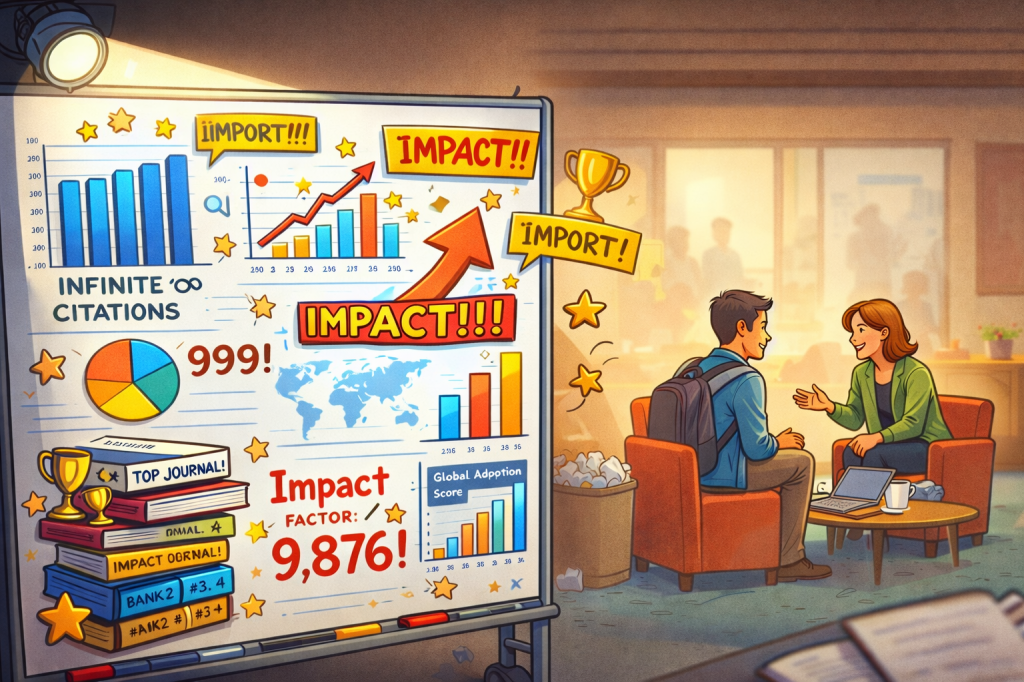
Publications, citations, journal rankings, h-indices… all neat numbers that tell the story of how much your academic work has mattered.
The Education Focussed (EF) model, where the emphasis is on teaching, pedagogy, curriculum, and innovation, has been a little trickier to measure quantitatively, but for better or worse, we’re catching up. Our impact is assessed by teaching-specific benchmarks, such as proving that our teaching initiatives have been adopted by lots of educators near and far (global is best!), that our curriculum design has changed how many teach, and that vast swathes of students have engaged with our resources.
These benchmarks are helpful as we EFs find ways to prove our worth as educators. But I’m convinced we’re missing something critical here.
The moments that can’t be measured
A colleague once told me about a professor she had as an undergraduate. She’d been struggling through the course when this person pulled her aside and told her, plainly, that she wasn’t stupid. They told her they believed she would pass and they believed in her.
And guess what? She went on to do a PhD.
Where does that go on an impact metric? You can’t count it. You can’t cite it. It won’t appear in any dataset. And yet, it is, without question, one of the most powerful things an educator can do. After all, pretty much every university’s mission statement contains some combination of: Transformative learning. Empowering students. Developing the whole person. My colleague’s moment with her professor was all of those things, distilled into one quiet conversation.
WE know what impact looks like
Those of us who teach know this territory well. The student who hangs around after the lecture and ends up in a conversation that they clearly needed. The LinkedIn message that pops up in your DMs years later, starting with “I don’t know if you remember me, but…”. The face (you know the face!) when something finally, actually clicks. The student who randomly enrolled in your course and then changed their entire degree because they loved it so much.
These moments don’t get counted anywhere official. But they are surely the most powerful impact there is. We’re changing lives, one person at a time. What greater success can there be for an educator?
Us fine educators should be presented with garlands and given tickertape parades, but instead, we find ourselves in a system that quietly insists this doesn’t count – because it can’t be measured. Teaching, especially for EF academics, is simply expected. It’s baseline. Being a great teacher, the kind students carry with them for decades, barely moves the needle on a promotion case.
It has to count
Now you and I, dear reader, know that this is nonsence. Relational impact – the one-on-one, in-the-moment, sometimes-completely-unplanned human connection that changes the direction of someone’s life – is as real as the citations on my Google Scholar profile. I’d go so far as to argue they’re even MORE impactful, if we consider the unlimited scope of each person to make positive change in the world.
So how do we keep operating in systems that haven’t yet found a way to recognise and reward what we’re good at?
The bleeding heart in me wants to say it’s enough that our students are impacted and changed… after all, that’s our mission in life, right? But let’s be honest — I’d also like a pay rise or a workload buy-out.
To be honest, I have no idea how we shift this entirely. It’s attitudinal, it’s systemic, and it’s tied to what is valued, both in universities and beyond. Yet, as I’ve argued before (HERE, for example), there are spaces where we have agency and perhaps the answer lies in making sure we’re amplifying our relational impact where it happens. That means sharing stories, highlighting voices, talking of others’ successes and generally not letting up until everyone knows what real transformation, real impact looks like.
We don’t need to wait for institutions to catch up before we start telling the truth about impact. Let’s keep telling it — loudly, and together.




 The Kind Academic
Leave a comment