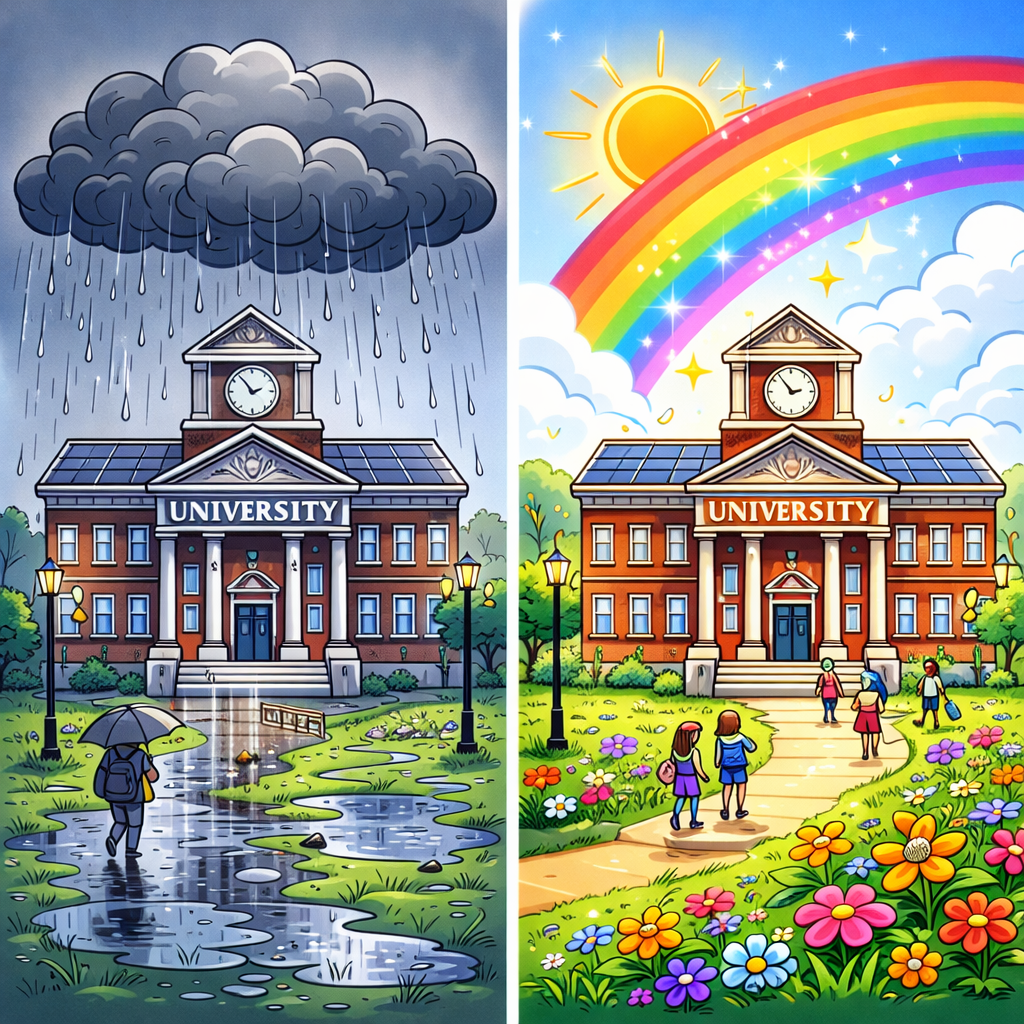
I am part of an academic book club — yes, nerd-alert! — and in searching for our next book to read, I accidentally stumbled upon an entire genre. I’ve informally named it “Everything in academia is effed.” Here are a couple of examples:
- Dark Academia: How Universities Die
- Dark Academe: Capitalism, Theory, and the Death Drive in Higher Education
- The University in Ruins
These are the titles of real books. Not just the imaginary ones I write in my head on the bus home after a bad day at work.
My first response to this genre was laughter. Wry Gabi thought it hilarious that higher education — the sector I’ve dedicated my studies and career to — is so toxic that it warrants its own Dewey Decimal code. Talk about #LifeChoices.
Once my manic cackle subsided, I started thinking about how it can be that I so deeply love academia when it is clearly so deeply flawed. As academics who pour everything into our roles (and I do think that’s most of us), how do we keep showing up, lecture after lecture, term after term, to a system that leaves many – students and staff alike – feeling troubled to the point of book writing?
It’s a question I keep coming back to. I don’t think the answer is simple, but I do think it starts with being honest about both sides.
We can – and should – confront the hard stuff
Staying silent is definitely not the answer. We don’t have to suck it up, and we shouldn’t. There are real systemic issues in academia, and it’s our prerogative to call them out. I know I do this, regularly. (See this post, and this one, and this one.)
As academics, we’re uniquely positioned not only to see the problems in the system, but to identify them, situate them in context, and find the words and data to tell the story. We have access to theories and frameworks to interpret the injustices we see — and in academia, there are, unfortunately, plenty of injustices to interpret.
Casualisation, precarity, wellbeing challenges for students and staff, implicit and explicit exclusions: these are everyday features of life in the academy. Those of us with job security and a foreseeable academic career ahead can and should speak out against the unfair practices and policies we see around us.
But if academia were only bureaucracy and broken dreams, many of us would have left long ago.
Small pops of why
Something keeps us showing up. I call these my small pops of why. They’re not grand or dramatic. They’re more like: a student’s face when they have that “aha” moment, a throwaway acknowledgement from a colleague that lands at exactly the right time, walking out of an awesome class buzzing with energy, or sharing your research with someone you just know will get it.
These are small moments, for sure. But they accumulate. And they matter.
The balance isn’t found – it’s made
So how do we hold the tension between devastating doom and perky positives? I think it comes down to agency.
As academics, we have voice. For better and worse, we write stuff that people read (thank you!) and when we say stuff, people listen. That gives us both the freedom and the responsibility to look up from our personal projects and try to make things better.
Nobody is going to listen to my proposal to overhaul the higher education system (DM for the full plan!). But here are things I can – and do – do:
Build communities of values-driven people, like the UNSW Kindness Network and our academic book club; mentor junior academics and support their skills development; create kind classrooms where students know they’re valued; bring good people together, making connections between students and staff who share values and interests.
None of these are revolutionary. But they give me enough purpose-driven meaning to keep showing up, day after day.
Where we’re headed
In case you’re wondering, my book club is going with something more positive this term. We’re steering away from the dark side, instead working through Becoming a SoTL Scholar as we develop our scholarly identities together.
At our weekly meetings, we’ll catch up on successes and failures, share our goals and cheer each other on. We’ll celebrate things we’ve tried, commiserate on the less-than-successful initiatives, and start new exciting projects. And in amongst all the challenges, big and small, we’ll connect as humans and be better together.
That last part sounds simple. But I think it’s actually the whole thing. If we can amplify that kind of connection across departments, faculties, institutions, and systems — then academia can’t not (yes, I double-negatived!) be the positive societal force we all know it can be.
Turns out, the genre I was really looking for wasn’t on the shelf at all. We’re writing it together, one small pop of why at a time.


 The Kind Academic
Leave a comment