At the recent QILT Higher Education Symposium, I found myself looking at a very familiar kind of graph:
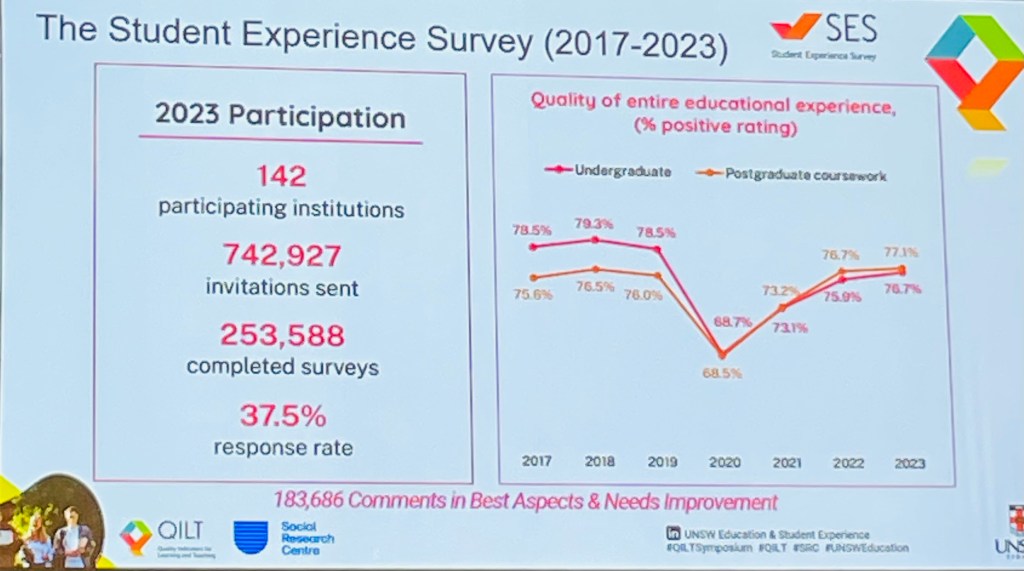
I’m sure you’ve seen lots of these too: student experience data plotted over time. For most institutions, the lines float along steadily for a few years, with maybe a little wobble here and there. And then comes 2020 and with it, a sudden dip in satisfaction, belonging, and engagement.
There was a moment of recognition in the room. A collective, quiet nod – “Ah yes… COVID”.
And then we swiftly moved on. The presentation shifted to the latest trends in the data and what that might mean for higher education today and in the future.
But I couldn’t stop thinking about that dip.
Whether we’re looking at higher education data, business reports, political analysis, socio-economic trends, or pretty much any other field, we’ve come to treat the COVID dip like a blip. An unfortunate but understandable outlier.
And I get it. That time felt so bizarre and is such a distant, fuzzy memory, that conjuring it up again feels counterproductive now that everything’s back to normal.
Still, the question’s lingered in my mind:
What might we be missing when we glance at the COVID dip… and then look away?
Signal, not blip
Like me, I bet you’ve seen this dip across all kinds of reports: student feedback, staff wellbeing surveys, performance metrics. During COVID, belonging dropped, burnout spiked, mental health spiralled. It’s all there, in the numbers.
And yet, when we read these graphs, it’s almost become habit to skip past that section. “Well, that was COVID,” we say, as if that explains everything.
But here’s what I’ve been wondering:
What if that dip isn’t just a blip?
What if it’s a signal?
What if it’s telling us something important, not only about what happened during the pandemic, but about what was already there before?
Because COVID didn’t just disrupt the higher education system – it exposed it. In our reactive rush to respond to the “new normal”, pressure points, cracks and vulnerabilities that already existed in higher education were revealed.
What the dip revealed
For students, it showed how precarious a sense of belonging can be when it’s only built on physical presence or surface-level engagement.
For staff, it showed how quickly things unravel when we’re stretched too thin, with too little support.
For institutions, it highlighted how much of the university experience depends on the unmeasured, unacknowledged labour of kindness, community-building, and care.
So instead of brushing that data aside, what if we paid closer attention?
What if we asked:
- What can this dip teach us?
- What truths did it uncover that we’ve been reluctant to name?
- And what would it mean to build back, not just “better,” but kinder?
What we can still learn from the COVID dip
The COVID dip shows us that higher education can only be better if we emphasise:
- Flexibility in how we teach, learn, and work.
- Communication that centres clarity, compassion, and humanity.
- Systems that support, not just extract from, the people who hold them up.
- A recognition that connection isn’t a “nice to have” in education: it’s foundational.
These lessons aren’t just relevant for pandemics. They’re relevant now. For the students navigating part-time work, caring responsibilities, and financial pressure. For staff holding space for others while managing their own burnout. For all of us trying to show up with presence in a system that often seems to reward productivity more than people.
Reading the signal
So when I see that dip in the COVID data, I don’t want to skip past it. I want to pause and ask what it revealed that we’re at risk of forgetting. Because underneath those lower scores were real people: students, educators, and communities across higher education held together by small acts of kindness that never made it into the reports.
And if we really listen, it might just show us the way towards something softer, more sustainable, and more deeply human in how we teach and learn together.



 The Kind Academic
Leave a comment